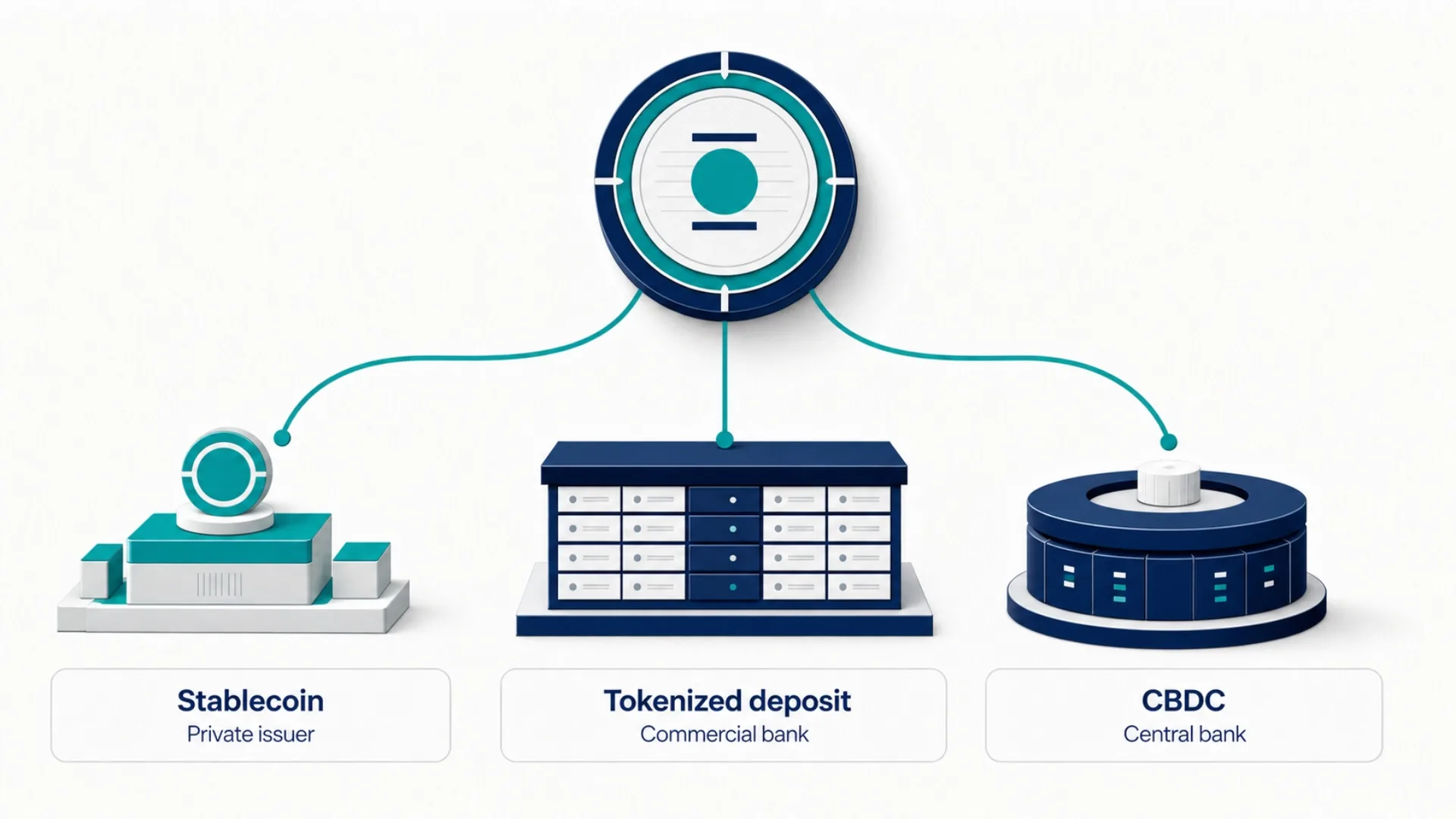
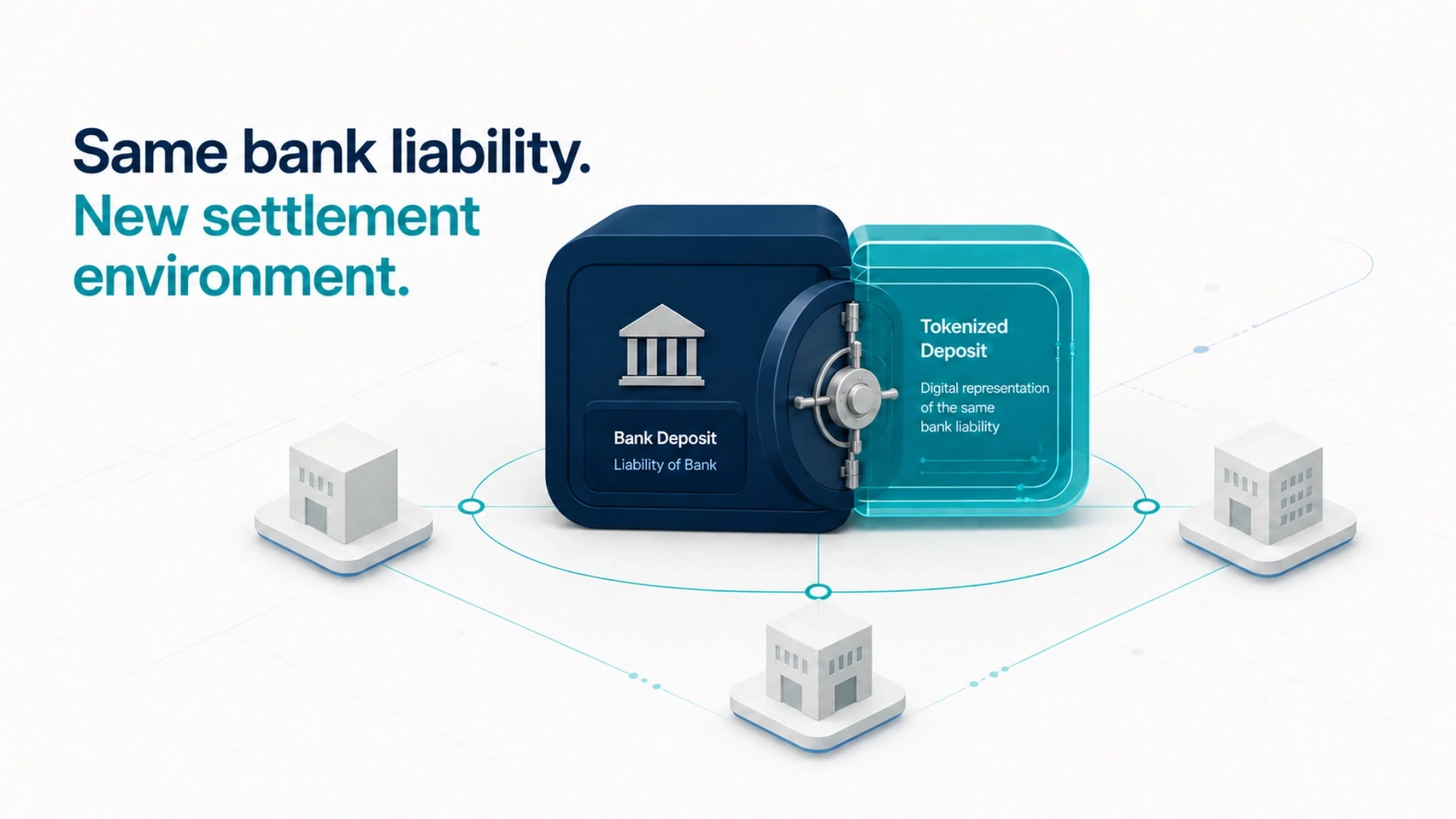
A tokenized deposit is not a new currency or a bank stablecoin.
It is commercial-bank money represented in a new digital form. The customer still has a claim on their bank, while the bank continues to manage the deposit relationship, compliance, liquidity, and settlement.
That distinction matters. A token can look similar to a stablecoin or a CBDC on screen, but the issuer and the holder’s underlying claim determine what kind of money it is.
For a broader explanation of the three forms, start with what tokenized money is.
What is a tokenized deposit?
A tokenized deposit is a bank deposit represented as a digital token on a programmable platform, such as a distributed ledger or another shared digital infrastructure.
The token represents money already held with a commercial bank. It does not necessarily create a separate pool of assets, and it does not change the basic fact that the bank owes the depositor.
In simple terms:
A tokenized deposit is the same bank liability in a new settlement environment.
A business may hold a conventional deposit balance in its account today. In a tokenized-deposit model, that balance could be represented and transferred through an approved digital settlement workflow.
The exact legal, operational, and regulatory treatment depends on the jurisdiction and the design of the arrangement. It should not be assumed that every tokenized-deposit model has the same features as every conventional deposit account.
There is no single tokenized-deposit model
“Tokenized deposit” is a broad label. A bank may design a model for its own customers, for participating institutions, or for settlement within a limited network.
Important design questions include:
- Who can hold and transfer the token?
- Does it stay within one bank or move across participating banks?
- What ledger or platform records ownership?
- How are identity, compliance, and transaction controls applied?
- How does the tokenized representation reconcile with the bank’s core records?
- What happens if a transaction fails or needs to be reversed?
The commercial promise may be similar across models, but the technical and legal design can vary significantly.
What changes and what stays the same?
The easiest way to understand tokenized deposits is to separate the familiar banking relationship from the new transaction layer.
| What stays the same | What may change |
|---|---|
| The issuing bank remains liable to its customer. | How value is represented and transferred. |
| The bank manages customer onboarding, compliance, and account relationships. | How payment, FX, and settlement workflows are coordinated. |
| Liquidity, risk management, and legal obligations still matter. | How quickly participants can reconcile and complete linked transactions. |
| The customer is still using commercial-bank money. | The ability to connect money with tokenized assets or approved transaction rules. |
Tokenization does not make the bank’s obligations disappear. Its potential value is in connecting payment, settlement, and recordkeeping more closely.
How do tokenized deposits work?
A tokenized-deposit workflow can be understood in four simplified steps.
-
A customer holds money with a bank.
The customer has an ordinary deposit relationship with the issuing bank. -
The bank creates a tokenized representation.
Within an approved system, the bank represents an amount of that deposit as a digital token. -
An approved transaction takes place.
The token may be used in a payment, an FX transaction, or the settlement of a tokenized asset, subject to the network’s rules and controls. -
Settlement and records are updated.
The bank updates the relevant records and maintains the underlying liability to the customer.
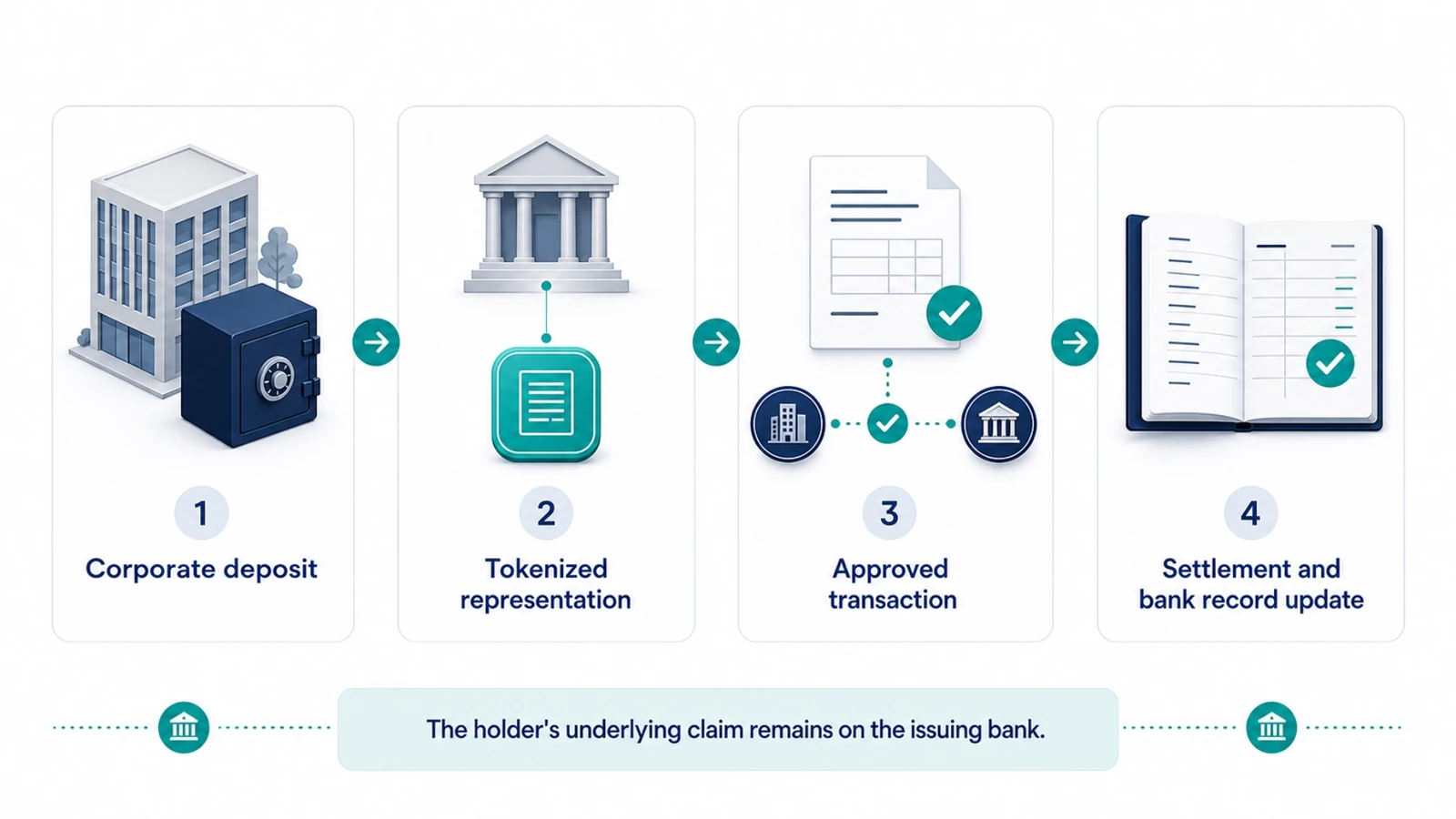
This is deliberately simplified. In reality, a bank must also address access controls, transaction finality, reconciliation, cybersecurity, sanctions screening, data governance, liquidity, and operational resilience.
Tokenized deposits vs stablecoins vs ordinary bank deposits
Tokenized deposits are often confused with stablecoins because both may use token-based technology. But the liability model is different.
| Question | Ordinary bank deposit | Tokenized deposit | Stablecoin |
|---|---|---|---|
| Who issues it? | Commercial bank | Commercial bank | Private issuer |
| What is the holder’s claim on? | The bank | The bank | The issuer and its reserve or redemption structure |
| How is it represented? | Account entry in bank systems | Digital token linked to the bank’s deposit relationship | Digital token |
| Typical role | Everyday banking and payments | Bank-led corporate, institutional, and settlement workflows | Digital-asset and emerging payment use cases |
| Main question | Is the bank relationship and payment access suitable? | How does it integrate with banking, settlement, and controls? | Are reserves, redemption rights, and governance robust? |
The comparison should not be reduced to “on-chain versus off-chain.” The more important question is whose liability the holder owns.
For a fuller comparison of stablecoins, tokenized deposits, and CBDCs, see the issuer and liability model behind tokenized money.
Why are banks exploring tokenized deposits?
Banks are not exploring tokenized deposits simply because the technology is new. The near-term interest is in improving specific settlement and liquidity problems.
Coordinated settlement
A cross-border transaction may involve a payment leg, an FX leg, several institutions, compliance checks, and different operating hours.
Where the infrastructure and legal arrangements support it, tokenized deposits could help coordinate linked transaction legs. This creates the possibility of atomic settlement, where both sides settle together or the transaction does not settle.
Atomic settlement is not the same as guaranteed instant cross-border payment. FX liquidity, compliance, market access, operating rules, and the receiving party’s readiness still matter.
But it can reduce the risk that one party has delivered value while waiting for the other leg to complete.
The BIS is exploring related questions through Project Agorá, which examines tokenized commercial-bank deposits and tokenized central-bank reserves for wholesale cross-border payments.
Better liquidity coordination
Banks and payment providers often maintain balances across currencies, correspondent accounts, and locations so they can complete payments through fragmented systems.
This pre-funding can leave liquidity trapped. Cash may exist in the network but not in the right account, currency, or place at the moment it is needed.
A shared settlement environment could improve balance visibility and coordination. Over time, that may reduce some pre-funding needs and make liquidity more efficient.
It does not eliminate the need for liquidity, FX, credit risk management, or settlement assets. It can, however, reduce friction created by disconnected processes.
Settlement of tokenized assets
Tokenized deposits may also become useful where a bank needs to settle tokenized securities, funds, trade assets, or other financial instruments.
If the asset and the money used to buy it can be coordinated in the same controlled environment, the transaction may be easier to complete safely and reconcile.
This is one reason tokenized deposits are relevant to banks even before broad consumer payment adoption. The early use cases are likely to be corporate and institutional.
Conditional workflows over time
Programmability is a genuine capability, but it is probably not the immediate universal business case.
Over time, approved rules could help connect a payment to conditions such as internal approval, delivery confirmation, an FX quote, collateral availability, or a securities transaction.
The near-term opportunity is safer settlement and better liquidity coordination. The longer-term opportunity is money that responds more directly to agreed business conditions.
What tokenized deposits do not solve
Tokenized deposits are not a shortcut around the difficult parts of payments.
They do not automatically:
- make every cross-border payment instant;
- remove the need for FX liquidity;
- eliminate compliance or sanctions screening;
- solve recipient onboarding and local-currency access;
- create legal certainty across every jurisdiction; or
- guarantee lower costs.
A useful test for banks and businesses is straightforward:
Does the tokenized design improve a real customer, settlement, or liquidity outcome, or does it only add technical complexity?
What is happening in Malaysia?
Malaysia’s tokenized-deposit work is beginning to take shape through controlled, regulator-led testing.
The starting point is Bank Negara Malaysia’s Digital Asset Innovation Hub, or DAIH. The DAIH is a controlled environment for testing digital-asset and tokenization use cases while BNM develops its understanding of the relevant policy, risk, legal, and operational questions.
Admission to the DAIH does not mean regulatory recognition, a live commercial product, or a market-wide launch. It is a structured way to test whether a proposed use case is workable and what safeguards may be needed.
BNM’s Digital Asset Innovation Hub lists tokenized deposits among the use cases being explored.
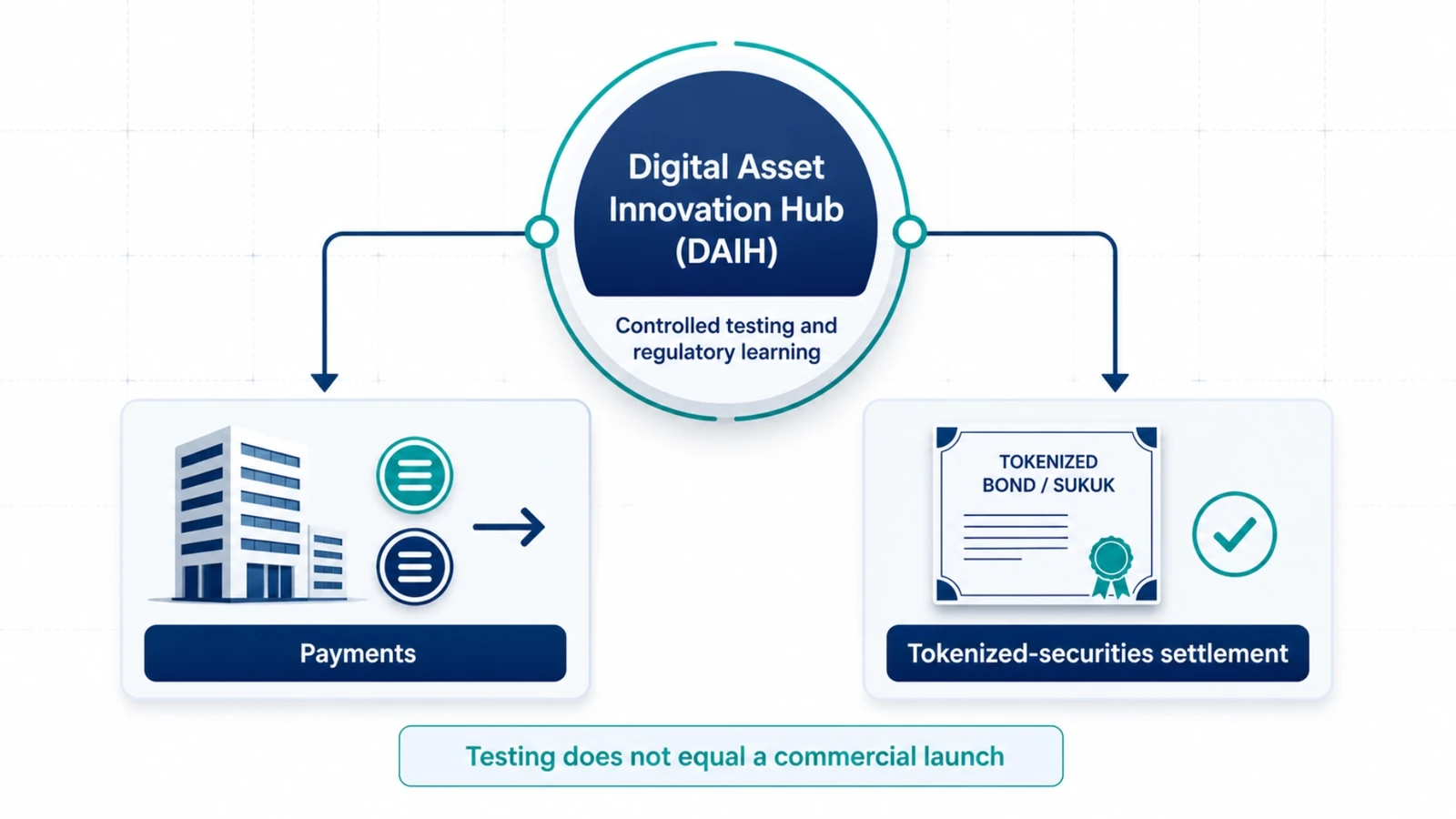
Within this framework, BNM has listed Maybank and CIMB as testing different tokenized-deposit use cases.
Maybank: a DAIH pilot for corporate cross-border payments
Maybank is exploring tokenized deposits for payments, including corporate cross-border use cases.
Its work indicates how tokenized commercial-bank money could be tested alongside payment and FX workflows in a controlled setting. The relevant question is not whether every Malaysian corporate payment is about to move on-chain. It is whether the model can improve settlement coordination, operational visibility, or liquidity use in a real business flow.
Maybank has described a pilot involving tokenized deposits for cross-border payments. Any assessment should treat this as an initiative under controlled testing, rather than evidence of a generally available product. Maybank: pilot announcement on LinkedIn
CIMB: a DAIH initiative for tokenized-securities settlement
CIMB is exploring tokenized deposits as settlement money for tokenized securities.
This is a different use case. Rather than focusing on a corporate payment corridor, the focus is on how commercial-bank money could settle transactions involving tokenized financial assets.
It reflects a wider institutional question: if securities and other assets become tokenized, what form of money should settle those transactions, and how should banks manage the associated controls and records? CIMB: bank-grade tokenisation through BNM’s Digital Asset Innovation Hub
What the Malaysian activity means
BNM has indicated that it intends to provide further clarity on ringgit stablecoins and tokenized deposits by the end of 2026. BNM: DAIH charts its 2026 strategy for ringgit stablecoins and tokenised deposits
The key significance is not that tokenized deposits have become live market infrastructure in Malaysia. It is that BNM is using controlled testing to inform how future rules, controls, and infrastructure may develop.
For banks and businesses, the sensible response is to follow the use cases closely, distinguish testing from deployment, and focus on the customer or settlement problem each model is trying to solve.
Five questions a bank should ask before building
Before pursuing a tokenized-deposit initiative, a bank should be able to answer five practical questions.
-
What specific problem are we solving?
Is the use case about cross-border payments, FX settlement, corporate treasury, tokenized assets, or another workflow? -
Who is the customer and what changes for them?
A technical capability is not enough. The customer outcome must be clearer, safer, faster, or more efficient. -
What remains inside the existing banking model?
The bank must be clear on the deposit relationship, regulatory perimeter, compliance obligations, and core-banking records. -
How will liquidity and settlement work?
Tokenization does not remove liquidity requirements. It changes how liquidity may be represented, coordinated, or used. -
What is the path from test to controlled scale?
A successful proof of concept does not automatically become a scalable product. Legal, operational, commercial, and interoperability questions remain.
What do tokenized deposits mean for businesses?
Most businesses do not need to become experts in distributed ledgers or token design.
They need to know whether a new payment or treasury arrangement can improve a real outcome:
- Can an overseas supplier be paid with less uncertainty?
- Can payment and FX settlement be coordinated more closely?
- Can treasury teams gain better visibility over available balances?
- Can a transaction be reconciled with less manual intervention?
- Are compliance, liability, and error handling clear?
For now, tokenized deposits are primarily an institutional development. Businesses should assess any proposed solution on reliability, cost, liquidity, compliance, and recipient experience.
The technology matters only if it improves one of those outcomes.
The practical takeaway
Tokenized deposits represent commercial-bank money in a new form.
They are not simply stablecoins issued by banks, and they are not a replacement for the banking system. Their potential is to make bank money work more effectively in controlled digital settlement environments.
The immediate areas to watch are coordinated settlement, liquidity efficiency, and the settlement of tokenized assets. Programmability may become important later, once trusted infrastructure, standards, and business adoption mature.
For Malaysia, the important signal is BNM’s DAIH. It gives banks a controlled way to test tokenized-deposit use cases before any broader commercial or regulatory conclusions are drawn.
Frequently asked questions
Are tokenized deposits the same as stablecoins?
No. A tokenized deposit is a claim on a commercial bank, represented in token form within an approved digital environment. A stablecoin is generally a token issued by a private entity and supported by its own reserve and redemption arrangements. The key question is not whether both use token technology. It is who owes the holder the money.
Are tokenized deposits the same as ordinary bank deposits?
They represent the same underlying commercial-bank liability, but they may change how that money is represented, transferred, and used in settlement workflows. The bank still manages the customer relationship, compliance, liquidity, and underlying records. The legal and operational details depend on the jurisdiction and the design of the arrangement.
Can tokenized deposits be used for cross-border payments?
Potentially, yes. They may help coordinate payment, FX, and settlement legs within an approved network, reducing some operational friction and settlement risk. They do not automatically make every cross-border payment instant, cheaper, or available in every market. FX liquidity, compliance, legal rules, and participant access still matter.
What is atomic settlement in tokenized deposits?
Atomic settlement means linked legs of a transaction settle together, or the transaction does not settle at all. For example, payment and FX legs could be coordinated so neither party delivers value while waiting for the other side. It is a settlement mechanism, not a guarantee of instant cross-border payments.
Why are banks exploring tokenized deposits?
Banks are exploring tokenized deposits for practical institutional use cases: coordinating cross-border payments and FX, improving liquidity visibility, reducing reconciliation work, and settling tokenized securities or other financial assets. The immediate opportunity is better settlement and treasury coordination, rather than replacing ordinary bank accounts.
Are tokenized deposits available in Malaysia today?
Malaysia is currently testing tokenized-deposit use cases through Bank Negara Malaysia’s Digital Asset Innovation Hub, or DAIH. Maybank is exploring tokenized deposits for payments, while CIMB is exploring them for settlement of tokenized securities. These are controlled initiatives, not evidence that tokenized deposits are generally available to businesses or consumers.
What should a business ask its bank about tokenized deposits?
Start with the business problem, not the technology. Ask whether the arrangement improves a specific payment, FX, treasury, or asset-settlement workflow; who can participate; how compliance and transaction controls work; how liquidity is managed; and whether the service is a test, a limited offering, or a live product.
Open Valley researches how tokenized money is changing cross-border payments in Malaysia and Asia. Follow for practical explainers, market research, and institutional perspectives.
Source list
- Bank for International Settlements, Project Agorá
- Bank Negara Malaysia, Digital Asset Innovation Hub
- Bank Negara Malaysia, Digital Asset Innovation Hub Charts 2026 Strategy with Focus on Ringgit Stablecoins and Tokenised Deposits
- Bank Negara Malaysia, Annual Report 2025
- CIMB, Advancing Bank-Grade Tokenisation Capabilities through BNM’s Digital Asset Innovation Hub
- Maybank, pilot for ringgit tokenised deposits (LinkedIn announcement)